Variability between breeds#
Variability between breeds is often attributed to many factors, some of them are not necessarily breed specific. In this section, I will try to isolate those that are mainly breed specific.
Beware that even the 100% pure sheep of a specific breed many differ between different countries. While merino more or less has uniform characteristics regardless of where it comes from, there are differences between Romney sheep in the US depending on whether it comes from the English or New Zealand blood lines of the Romney sheep.
Also consider whether the sheep breed is new to US or has been domesticated for a long time. Sheep tend to adapt to the conditions of where they live, what they eat and start to evolve as a result. Navajo Churro sheep is a heritage breed well-adapted to the harsh conditions of the dry and extremely hot temperature of the Southwest through many generations Navajo-Churro Sheep Association. Gulf Coast Native sheep on the other hand adapted to very hot and humid conditions. Both breeds were originally brought in by the Spanish in the 16th and 17th century.
Since 2020’s, the U.S. has allowed the import of sperm and more recently embryo from abroad. This resulted in new breeds and blood lines being introduced to the U.S. The process to up-breed using spems results in mix-breeds, for example sperm of breed X with a ewe of breed Y produces a sheep that is 50% X and 50% Y breed. Breeding a ewe with 50% X breed using sperm of breed X produces a sheep that is 75% X. This process approximates pure breed over time, but the resulting sheep may still retain some of the characteristics of the original breed Y. An embryo results in a 100% pure breed and is a faster but more expensive process. Some shepherds have used this process to introduce new blood lines of the same of breed of their own flocks. Ultimately, these wool characteristics of these blood lines may still change over time as they adapt to specific regions the sheep are being raised in. This means also some breeds are still fairly new to US and their wool characteristics may change over time. Valais Black Nose Sheep is one of the sheep in this category.
The best way to understand the characteristics of the wool based on a breed is to understand the blood line and the age of the sheep being used and to sample from different farms over different years to control for variations due to weather conditions. It is not surprising that commonly raised breeds provide more data points and our knowledge of them is more reliable. Any information on rare breeds is likely to be more unreliable.
One can also infer the breed characteristics from similar breeds. For example, tunis is one of the oldest breeds in US, brought from North Africa in 18th century. Since they have been used in crossbreeding extensively, other similar breeds are also common such as the Katahdin and California Red. These breeds have similar characteristics to Tunis. Similarly, the upbreeding process also results in breed mixes where some of the characteristics of the base breed may be maintained. This may be very desirable to wet-felters as I will discuss later on.
Fiber thickness#
Since wet felting requires fibers to move freely to get enmashed, their thickness is an important factor in their felting ability.
The most common way to categorize wool is based on the fiber diameter:
Fine wool (eg. Merino, Cormo, Rambouillet, Targhee)
Medium wool (eg. Corriedale, Cormo, Finn, Romney, Jacob, Gotland, BFL)
Coarse wool (Karakul, Herdwick, Rya, Devon, Akkaraman, Llama, Valais)
Fine wool (12-21 micron) generally felts very quickly and densely. It is nice to touch for anything that will touch the skin. It has the potential for drape for wearables (depending on thickness).
Fine wool felt is not as durable for heavy usage items like shoes and bags that will carry some weight.
Some fine wool may felt well but may have the potential to pill over time. Alpaca is potentially such a fiber.
Medium Wool (21-35 micron) generally felts well, but felting takes longer and there is variation in the density of the felt among breeds. Very dense felting wool is preferred for heavy use items like slippers and shoes (Finn, Gotland, Bergschaff), while the rest can be used for bags as well as carpets and other uses (Corriedale, BFL, Romney).
Medium wool can be scratchy against the skin. One can use fine wool as a layer on top to improve the touch, as well as other fibers. Medium wool is also good for 3d objects and shaping.
Coarse Wool (35+ micron) often contains breeds that are dual coated or have hair or kemp in it. Generally all will felt together and get trapped. The result is a very strong felt, almost waterproof. Carpets are a good use for these. Shepherd cloaks are also made this way.
Some coarse or medium fibers have interesting properties, such as producing web like transparent structure (Wensleydale) that could be used for lighting fixtures.
Other breed characteristics#
Scale structure#
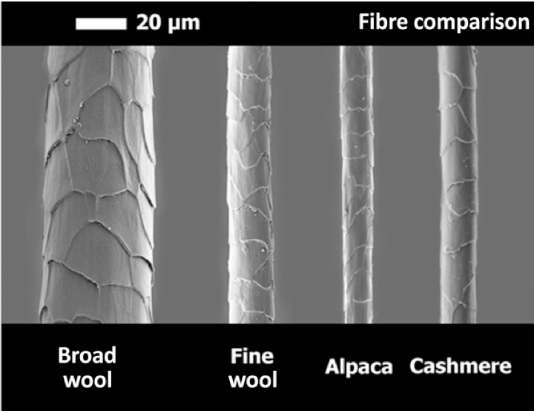
No matter how fine the fiber is, some wool will still not felt very well. This is likely attributable to the structure of the scales (barbs) in the wool. As wool gets wet, the fibers absorb the water, they get longer and the scales open. This means that as the fibers move with the agitation process, the barbs entangle with each other.
It is generally known that finer fiber have more scales per inch than a coarse felt. Many felters find fine alpaca fibers to be slippery. The picture below shows the difference in the scale structure, alpaca wool having more uniform scales compared to sheep wool. Fibers with little or no scales will not felt at all. The superwash process is a way of coating the fibers so that the scales are covered.
Breeds that do not wet felt#
Most breeds will felt to some degree, but some will take much longer and produce a very loose felt. The worst breeds for wet felting are the down breeds (eg. SouthDown), CVM and Maori. These do not felt at all, which is great for uses where wet felting is not desirable. It is not very clear why these breeds do not felt well, but my main guess so far has to do with their scale structure.
Note that needle felting has a totally different variables and operate in different dimensions. A fiber that does not wet-felt well may be great for needle felting.
##Mixed wool sheep
Some sheep are dual-coated having wool with different characteristics. Sheep may have a softer and short down wool mixed in longer coarser wool or hair. These two wool may have different characteristics. In some breeds, the shorter wool may not felt well but the longer wool does. In other breeds, they may both felt but in different ways. So one needs to understand which part of the wool from this breed is being used in felting.
Some breeds have kemp mixed in their wool. Kemp is an inflexible fiber that often does not felt well but gets trapped during the felting process. Herdwyck is an example of a breed with kemp. Sometimes the kemp fibers that do not get trapped will just peel out as the felted becomes denser. While kemp is not a desirable part of the wool during felting, it does not impact the quality of the felt greatly either, especially for rugs. In other fiber processing, kemp is said to take dye differently and this property is used in making of tweed fabric.
Fiber length and fiber ends#
Fiber length greatly impacts how fiber can be laid out. Often very long fibers are hard to use for laying out small objects. The more important characteristic is the presence of fiber ends that are more active during felting, moving through layout laters. A well-known example is when using cut prefelts, the halo of the cut edges is often more visible after felting. Shorter fibers often have more fiber ends, resulting in denser felt. The extreme example is the super short kap wool that felts very densely so much so that if cut after felting is complete, there is no need to heel the cut since there is no unfelted ends that need to be processed.
Fiber length also plays a big role in three dimensional objects since a longer fiber has more ability to shape and fold itself in different configurations. This means that it can move a 3-d object in more dimensions, making it possible to shape it in various ways. However, the resulting object may not be tight in the 2-d space. We will discuss this in more detail in felt quality and characteristics. Very short fiber on the other hand will have a very dense looking felt but the underlying object will not shrink much in the 3-d space.
Other remaining questions#
Does fiber crimp have an impact in felting? Other breed specific variables?