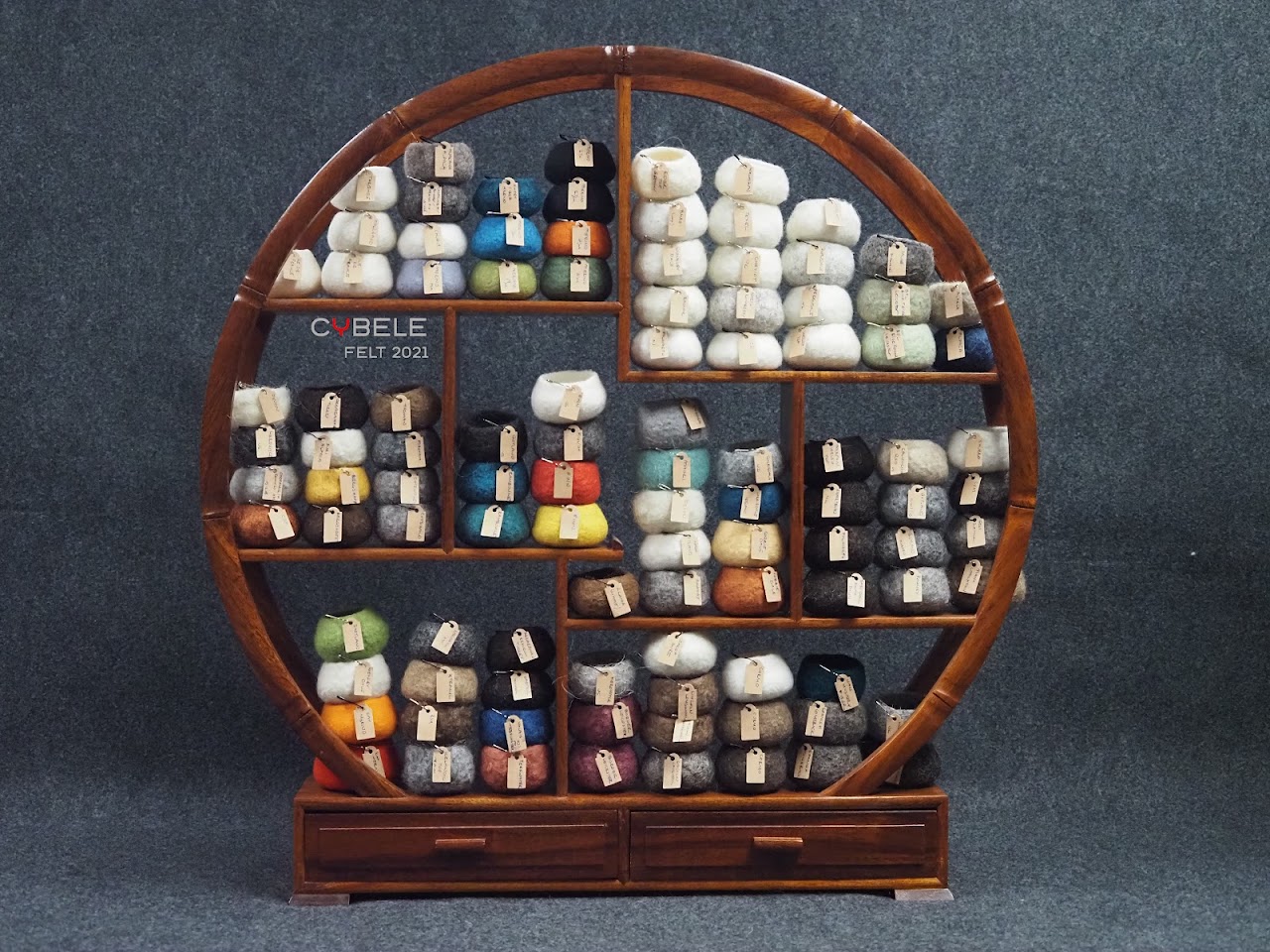
Chapter 1. Factors impacting felt quality#
The wet felting process involves moving fibers with the help of water and agitation to create an unvowen fabric. This results in fibers moving around to form a random organization and the scales (barbs) in the wool to get caught up with each other to lock them in place. The resulting felt quality, look and feel of it, its density, flexibility, drape and overall structure can vary greatly based on a large number of variables. Crafts people and artists have depended on these variables for centuries to produce felt for a large number of different uses. The breed of sheep or other wool animals are one of the many factors that impact felt quality and structure.
In this chapter, I will summarize these variables and group them into four basic groups:
Fiber processing
Animal husbandry
Breed characteristics
Wet-felting process
First, let’s consider each group in isolation and its impact on the fiber and the resulting felt.
Fiber Processing#
The process to prepare the fiber may have a big impact in the felting ability of wool. Examples are:
The cleaning process: the temperature of water used to scour wool, chemicals used, level of fiber manipulation, amount of lanolin left
The carding process to produce roving or batting, breakage of fibers which produces more fiber ends, the orientation of wool (single direction in roving vs. random in batting).
The use of chemicals: chemicals used in post process to coat the fibers and dye them
Animal husbandry#
The large number of variables may exist within a single breed of wool producing animal used in wet felting. These would impact the quality of the wool from farm to farm, from season to season. Examples are:
The domestication process: selection of animals for wool quality, genetic diversity in the farm
Labelling conventions for sheep/wool, availability of registry for the breeds
Variability of wool quality within the animal, some animals naturally have many different quality of wool on them (eg. llama)
Age, well-being, nutrition of the animal, winter vs. summer coats
Variability between breeds#
Variability between breeds is sometimes attributed to many of the other factors described in this chapter. It is important to distinguish between the breed based criteria by using many different samples of the same breed from different farms and sources.
Additionally, beware of the granularity for describing the breed. The breed name is not always sufficient.
The main variability between breeds is understood along a number of basic dimensions:
Fiber thickness (fine, medium, coarse)
Fiber length (short vs. long)
Fiber composition (dual coated, hair and kemp mixed, crimp or not crimp)
In addition, there are a number of less documented properties such as the structure of the scales which likely play a role as well.
Process used in wet-felting#
The process of wet-felting goes back to ancient times and is surprisingly unchanged since then. Through experimentation, some ancient and some recent, many variables have been discovered. We outline a few here. Each will constitute their own section later.
Layout: thickness of layout, directionality of the layout
Process: soap used, temperature, agitation process, the amount and direction of manipulation
Mixing with non-felting (or hard-felting) fibers, including cellulose fibers (rayon, bamboo, tencel), protein based fibers (silk), metal fibers. Additionally, using fabric and paper of many types in felting.
Additionally mixing of felting fibers in different ways is another topic worth discussing. I will go over this in particular when mixing different breeds of fibers either by carding them together, layering them horizontally or by using different fibers in different parts of the layout. Of course, fiber genetics may also mix in sheep, which in itself is an interesting topic of discussion.